
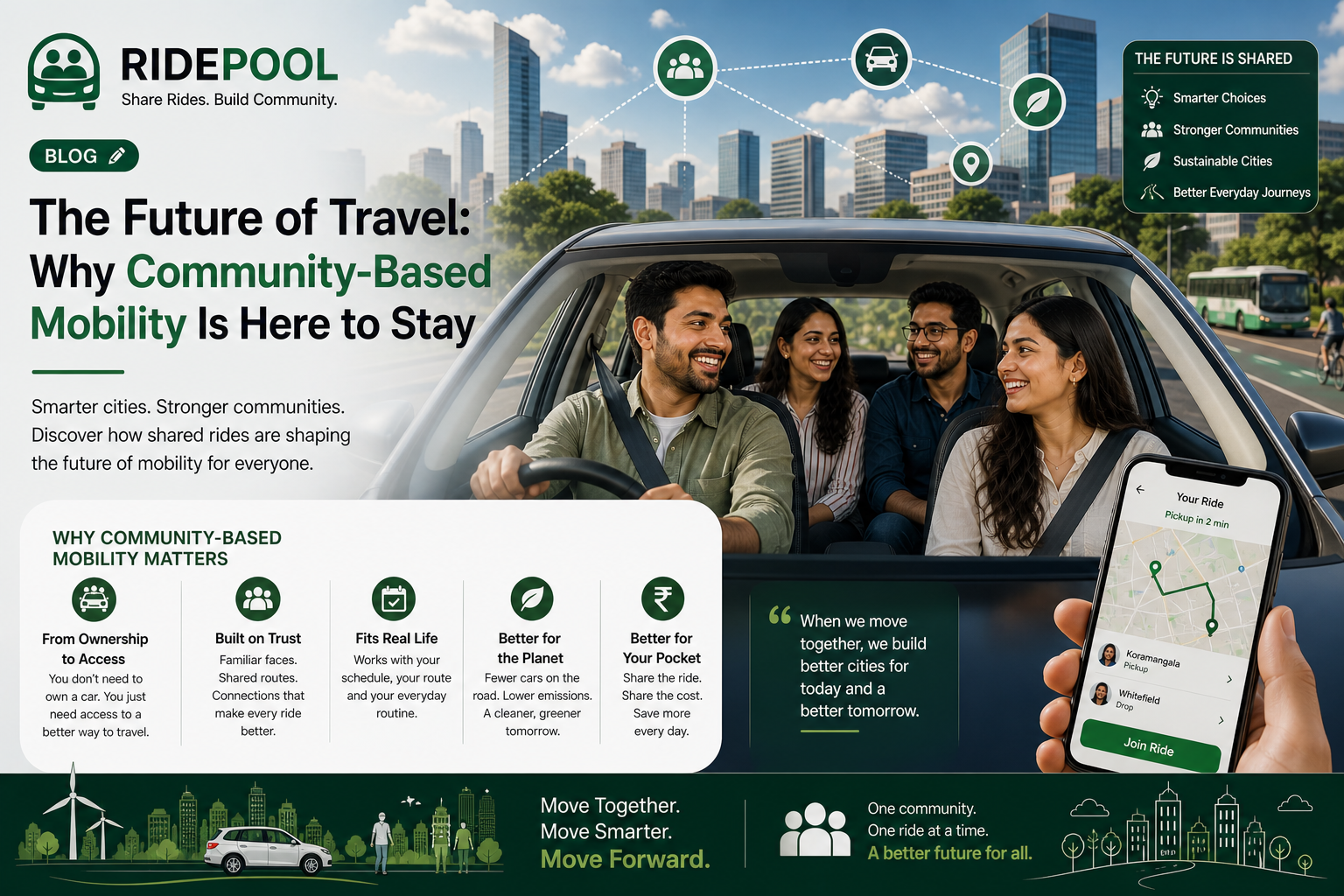

he way we travel is changing.
Not dramatically overnight—but steadily, quietly, and in ways that are starting to feel permanent. In cities like Bangalore, where daily commuting is a shared challenge, people are beginning to rethink not just how they travel—but why.
And at the center of this shift is something simple: community.
From Ownership to Access
For years, owning a vehicle was seen as essential.
It meant independence, convenience, control.
But today, that mindset is evolving.
People are realizing:
- You don’t always need to own a ride
- You just need reliable access to one
Ridepooling fits naturally into this shift—giving people flexibility without the burden of ownership.
The Rise of Shared Mobility
We’re already seeing it everywhere.
- Shared workspaces
- Shared homes
- Shared services
Mobility is following the same path.
Instead of every individual solving the same problem separately, shared mobility brings people together to solve it collectively. It’s more efficient—and more sustainable.
Trust Is the New Infrastructure
What makes community-based mobility possible isn’t just technology—it’s trust.
People are more open than ever to:
- Sharing rides with others on similar routes
- Building familiarity through repeated interactions
- Being part of systems that rely on mutual respect
Over time, platforms don’t just facilitate rides—they enable relationships.
Designed Around Real Life
The future of travel isn’t about forcing people to adapt.
It’s about fitting into their existing routines.
Ridepooling works because:
- It aligns with your daily schedule
- It uses routes you already take
- It improves your commute without adding complexity
That simplicity is what makes it scalable.
A More Sustainable Direction
As cities grow, sustainability is no longer optional—it’s necessary.
Community-based mobility helps by:
- Reducing the number of vehicles on the road
- Lowering emissions without major lifestyle changes
- Making better use of existing resources
It’s not about doing less—it’s about doing things smarter.
Why This Isn’t Just a Trend
Some changes fade. Others stick.
Community-driven mobility is likely here to stay because it solves multiple problems at once:
- Cost
- Convenience
- Congestion
- Connection
And when something improves both individual experience and the broader system, it tends to last.
Final Thought
The future of travel won’t just be faster or more advanced—it will be more shared.
Because the smartest way forward isn’t traveling alone.
It’s moving together.